Hinode EIS Observations of Plasma Composition Evolution and Radiative Cooling of Flare Loops
Teia Mihailescu (INAF)

Plasma composition in flaring regions has been shown to have significant spatial and temporal variations, likely driven by dynamical processes that take place as a consequence of the sudden energy release at the reconnection site. The origins of these variations, as well as the effects they might, in turn, have on flare loops dynamics are not yet fully understood. In this work, we investigate the plasma composition evolution and its link to plasma cooling times in the loops formed following the M-class flare peaking at 13:56 UT on the 2022 April 2 using high cadence Hinode EIS spectroscopic observations.
Hinode EIS Observations
Hinode EIS observed the flare loops evolution using a sit-and-stare study which captured a portion of the flare loop arcade top and one of the footpoints (see Figure 1). The plasma composition evolution was characterised using the Ca XIV 193.866 Å/Ar XIV 194.401 Å diagnostic and a DEM analysis. Given the narrow temperature distribution of the structure, a Gaussian shape was assumed for the DEM function. Observations indicate a systematic difference in plasma composition along the loop, with the loop top exhibiting a FIP bias of 2.8± 0.2, higher than the 2.4± 0.2 value observed at the footpoint (see Figure 2).
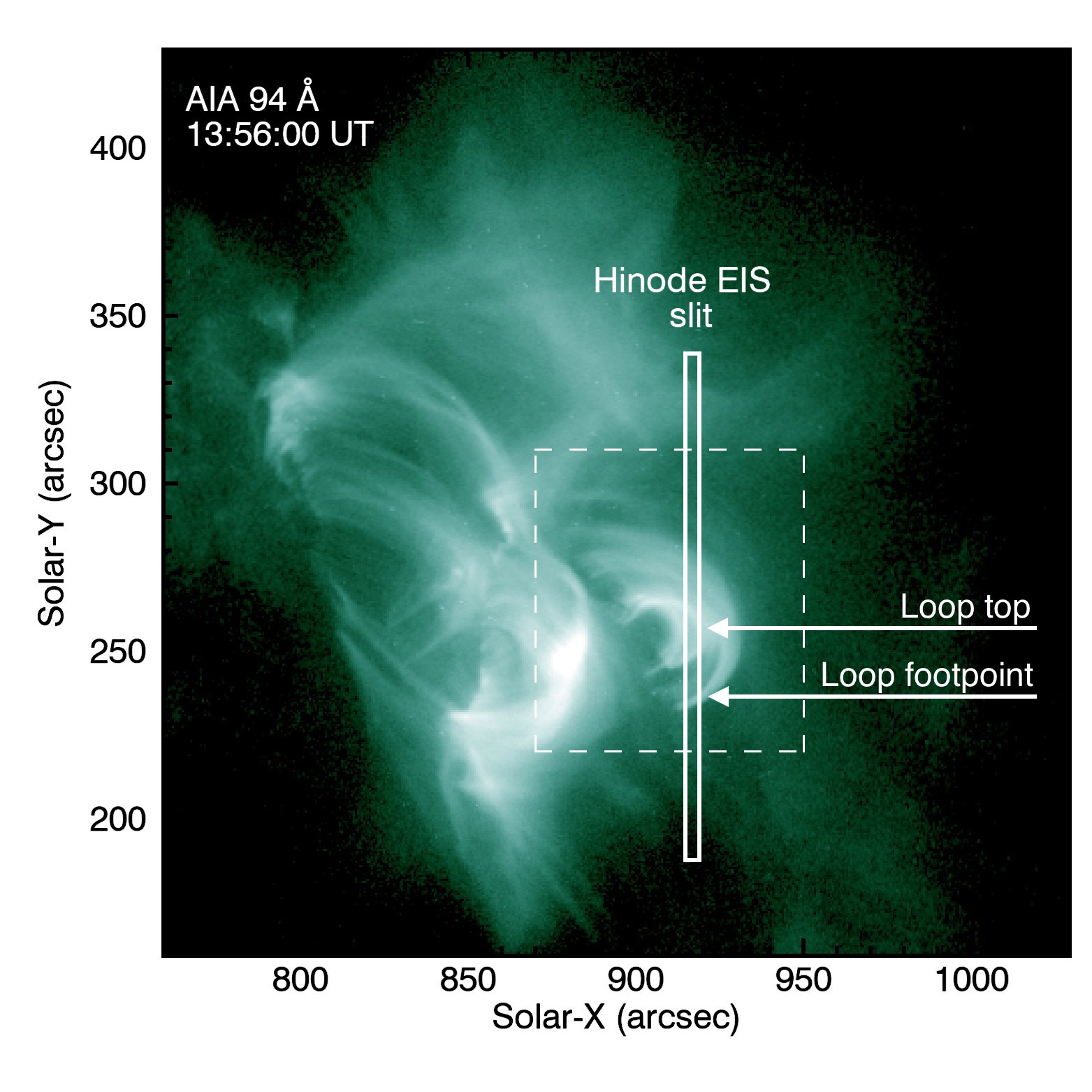
Figure 1: Context AIA 94 Å image of the flare loops associated with the M3.9 flare peaking at 13:56 UT on 2022 April 2. The solid white rectangle indicates the position of the EIS slit for the Fe XII 195.119 Å window, and the dashed white rectangle shows the loop arcade studied in this work.
The evolution of line intensities covering a wide temperature range (log(T) = 5.72 - 7.25) was used to track the cooling times, revealing shorter cooling times at the loop top compared to the loop footpoint (see Figure 4). The evolution of the Gaussian centroid temperature also shows a steeper slope for the loop top than footpoint, providing additional indication that the flare loop top is cooling faster than the footpoint.
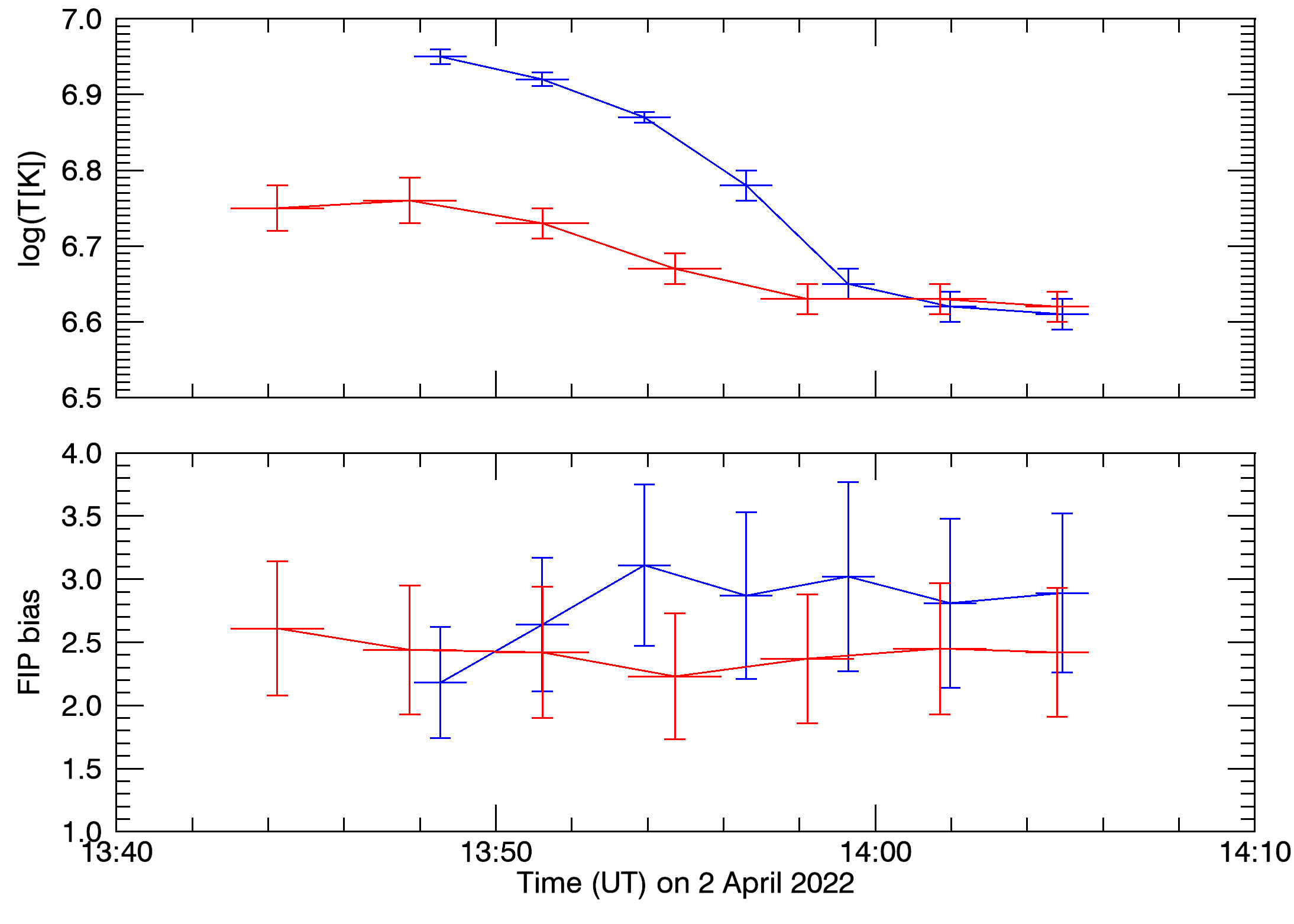
Figure 2: Evolution of Gaussian DEM centroid temperature (top) and associated FIP bias (bottom) for the loop top (blue) and loop footpoint (red).
EBTEL Simulations
The radiative loss function depends on plasma composition, particularly in the temperature range where emission is dominated by low-FIP elements (see Figure 3; Cook et al. 1989). We investigate the effect the spatial variation in FIP bias observed along the flare loop could have on the loop cooling times using simulations from the EBTEL 0D hydrodynamic model. The EBTEL simulations show that the observed difference in FIP bias between the loop top and footpoint is sufficiently high to produce a noticeable difference in cooling times, with the higher FIP bias leading to a faster radiative cooling rate (see Figure 4).
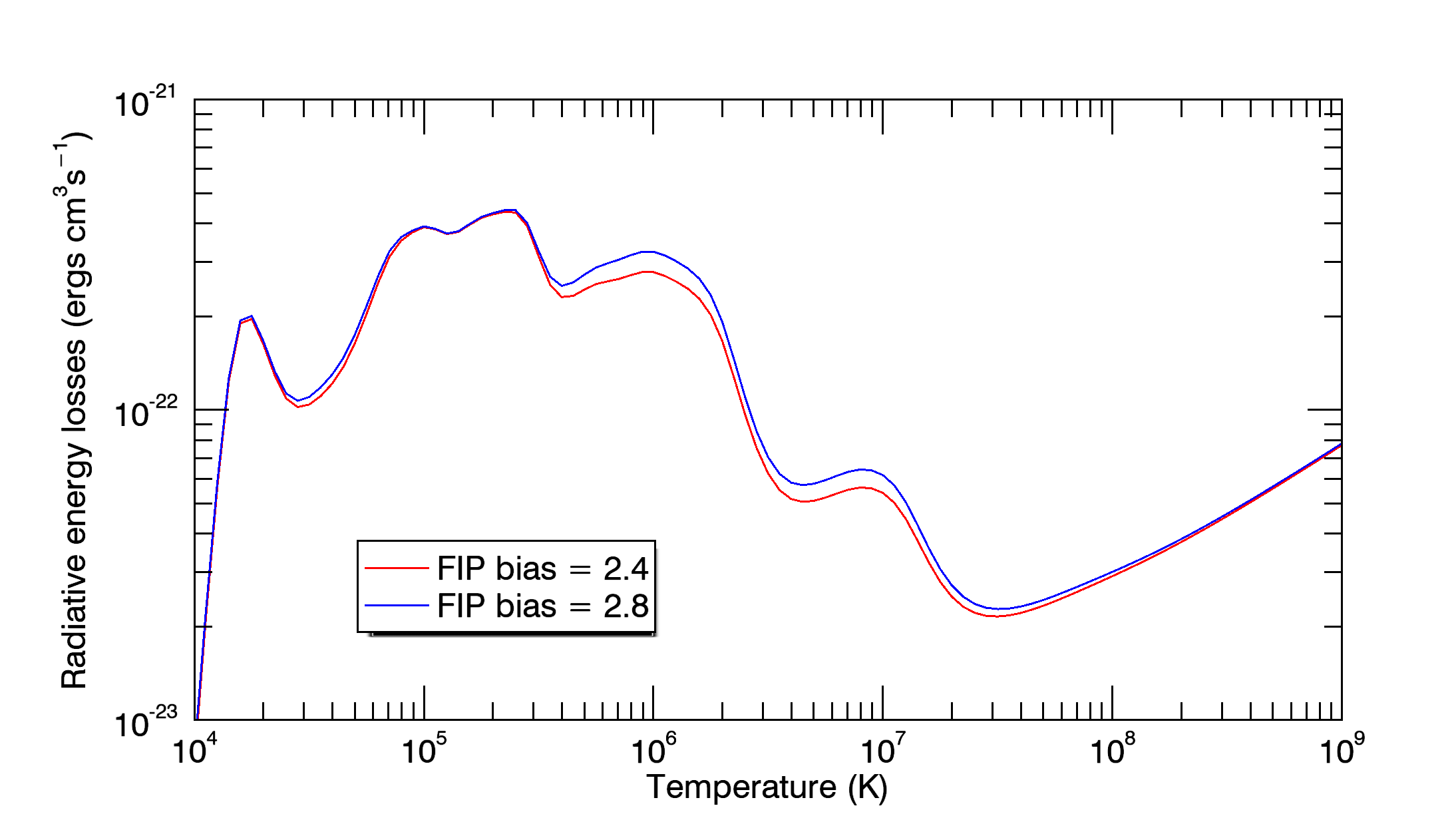
Figure 3:
Radiative energy losses, Q(T,Ne), as a function of electron temperature in the case of plasma with FIP bias = 2.4 (red) and FIP bias = 2.8 (blue), assuming the default CHIANTI ionisation file and an electron density of 1010 cm-3.
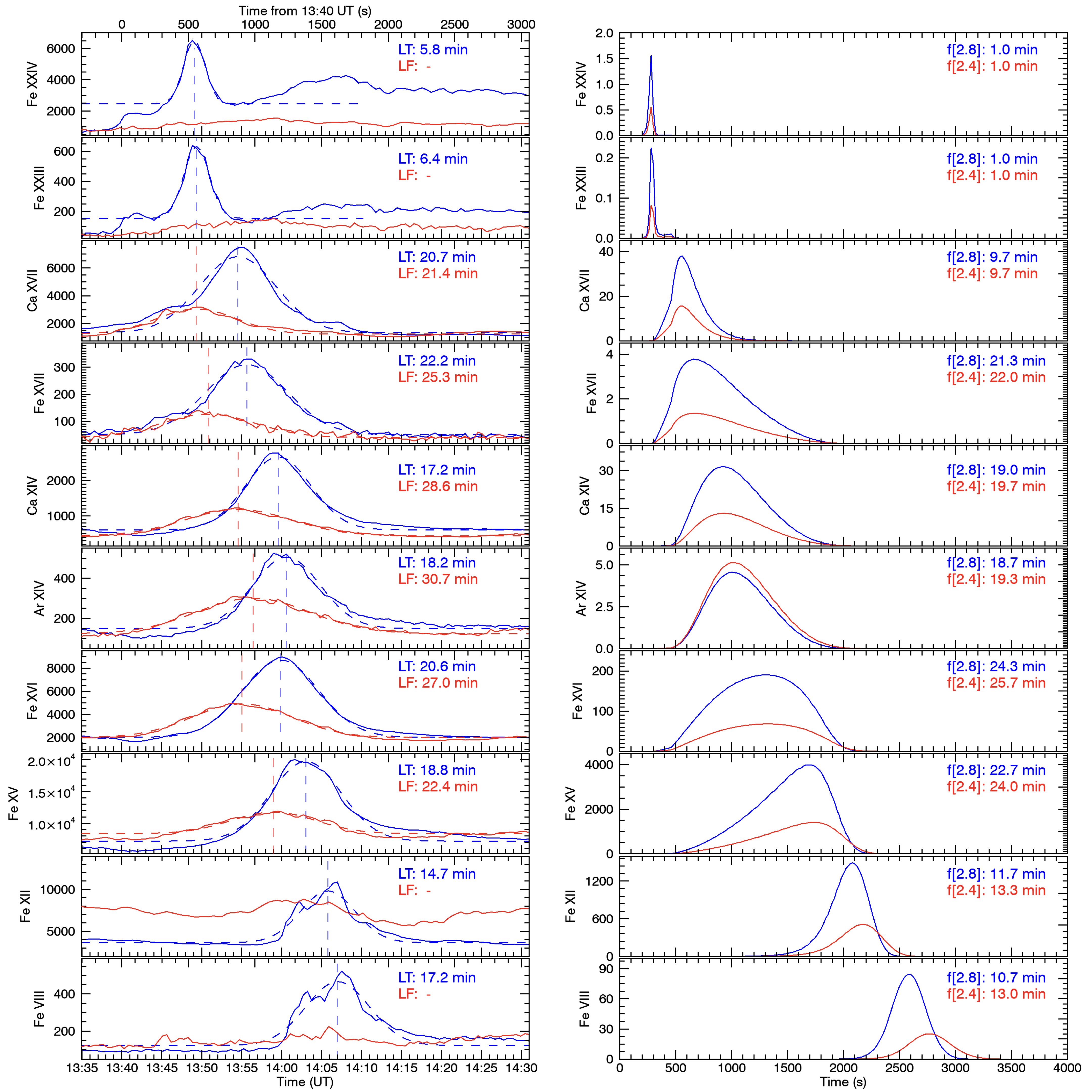
Figure 4: Intensity evolution comparison between observations and simulations. Left: Averaged Hinode EIS spectra intensity evolution in the loop top (blue) and footpoint (red). The peak emission times for each feature in each line are indicated by the vertical dashed lines. Right: Synthetic intensity evolution computed using an EBTEL simulation of a heating event in a single loop strand, assuming a plasma with a FIP bias = 2.8 (blue) and a FIP bias = 2.4 (red) respectively. Lifetimes are indicated in the top right corner of each plot.
Conclusions
The observed FIP bias values are higher than those reported in some previous studies which found photospheric composition during flares. While several aspects need to be considered when comparing our results to previous ones, the relatively high FIP bias values we observe suggest that, in this particular event and flare stage captured, the energy deposition and consequent chromospheric evaporation take place above the fractionation level in the chromosphere.
The consistently higher FIP bias and shorter cooling times at the loop top compared to the loop footpoint suggest a faster radiative cooling rate. Previous studies have reported even stronger spatial variations in FIP bias along flare loops (e.g., Doschek et al. 2018), suggesting that the influence of plasma composition on heat transport and loop cooling may be even more significant in more energetic events.
For more details, see:
Mihailescu et al. (2026), accepted to ApJ. Preprint available at:
Hinode EIS Observations of Plasma Composition Evolution and Radiative Cooling of Flare Loops
References
Cook, J. W., Cheng, C.-C., Jacobs, V. L., & Antiochos, S. K. 1989, The Astrophysical Journal, 338, 1176
Doschek, G. A., Warren, H. P., Harra, L. K., et al. 2018, The Astrophysical Journal, 853, 178
Next EIS Nugget »» coming soon...
TBC
Last Revised: 27-Oct-2011
Feedback and comments: webmaster
|


