Full-disk spectroscopy of the solar corona across a solar cycle
James McKevitt (UCL/MSSL)

The solar corona changes significantly as the Sun goes through its magnetic cycle. When we observe the Sun, or other solar-like stars, as a single unresolved point of light, we see this variability clearly in X-ray and extreme ultraviolet (EUV) emission. Previous work in stellar contexts has suggested these variations are driven by changes in the proportion of the stellar disk covered by active regions (filling factor), rather than changes in the fundamental properties of the coronal plasma itself (e.g., Orlando et al., 2001; Morgan & Taroyan, 2017). Spatially-resolved EUV spectroscopy allows us to test this idea by decomposing the integrated full disk emission into its constituent components emitted by different magnetic structures.
Hinode/EIS Full Disk Observations
In our study we use observations of the Fe XII 195.119 emission line as seen in 18 full-disk spectroscopic mosaic scans taken by Hinode/EIS (Kosugi et al., 2007; Culhane et al., 2007) taken between 2013 and 2024. This period covers the period from the peak of solar cycle 24 to the rise of solar cycle 25, letting us track the long-term behaviour of the million-degree (log T 6.2) corona across the whole disk.
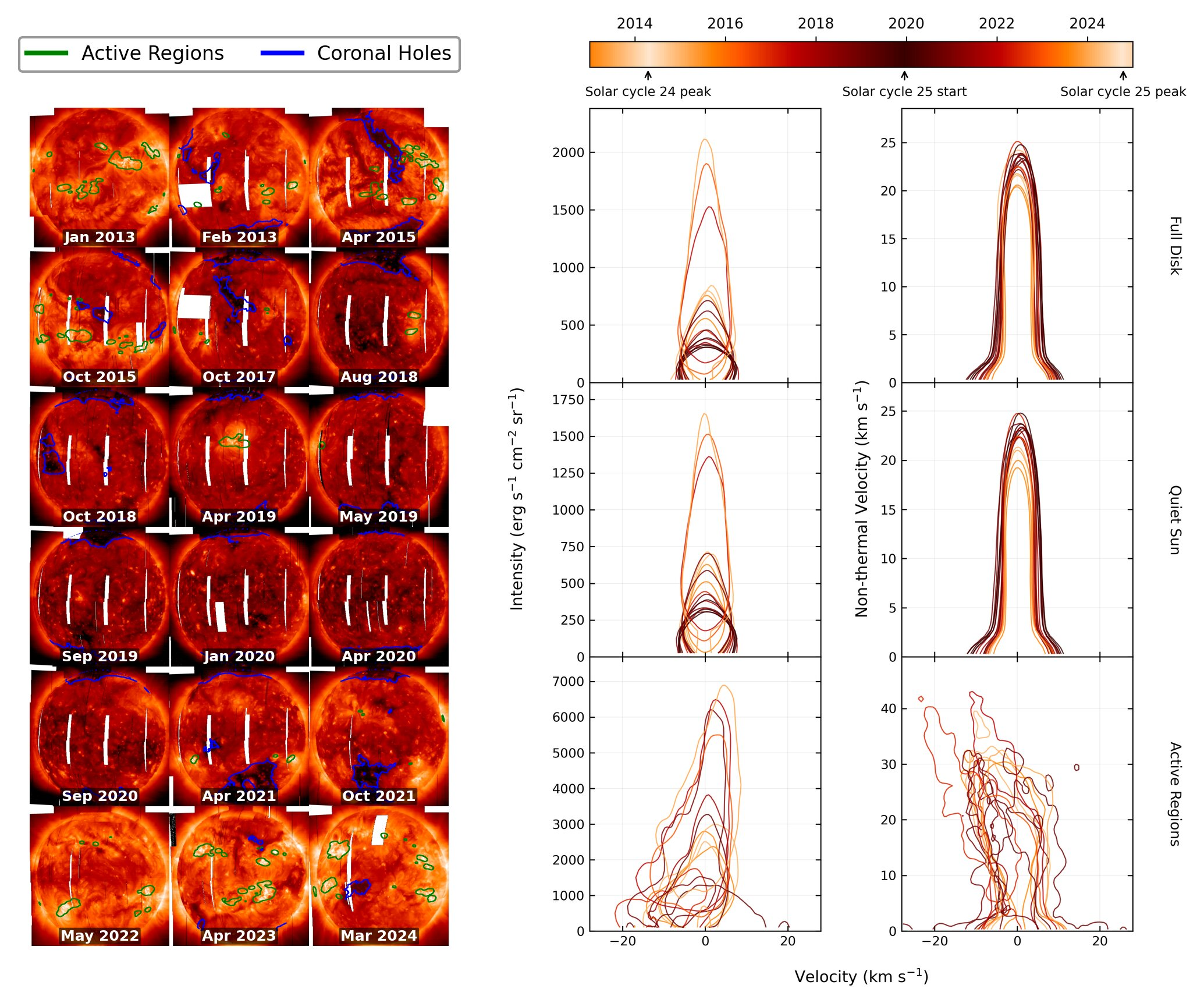
Figure 1: eft: Full-disk spectroscopic mosaics taken by Hinode/EIS used in this study, with active region and coronal hole masks outlined in green and blue respectively. Right: Distributions of plasma intensity, velocity, and non-thermal velocity at different points in the solar cycle, identified using contours at 75% of the histogram density for each disk.
We processed these mosaics using the EISMaps pipeline EISMaps (McKevitt et al., 2026a) to make spatially-resolved full-disk maps of plasma intensity, Doppler velocity, and non-thermal velocity. We decompose distinct magnetic features on the disk using Space-weather HMI Active Region Patches (SHARP) from SDO/HMI (Scherrer et al., 2012; Bobra et al., 2014) to identify active regions and the neural network method of Jarolim et al. (2021) applied to SDO/AIA imaging to identify coronal holes. We then label as quiet Sun plasma anything which is not found to be active region or coronal hole plasma. We show this masking, and the distribution of plasma parameters in each plasma type, throughout the solar cycle in Figure 1. We didn't see any clear solar-cycle variation in the distributions of coronal Doppler or non-thermal velocity in either active regions or the quiet Sun, though their total intensities do track the cycle. The well-established correlation between upflowing plasma and elevated non-thermal line broadening in active regions persists throughout the cycle.
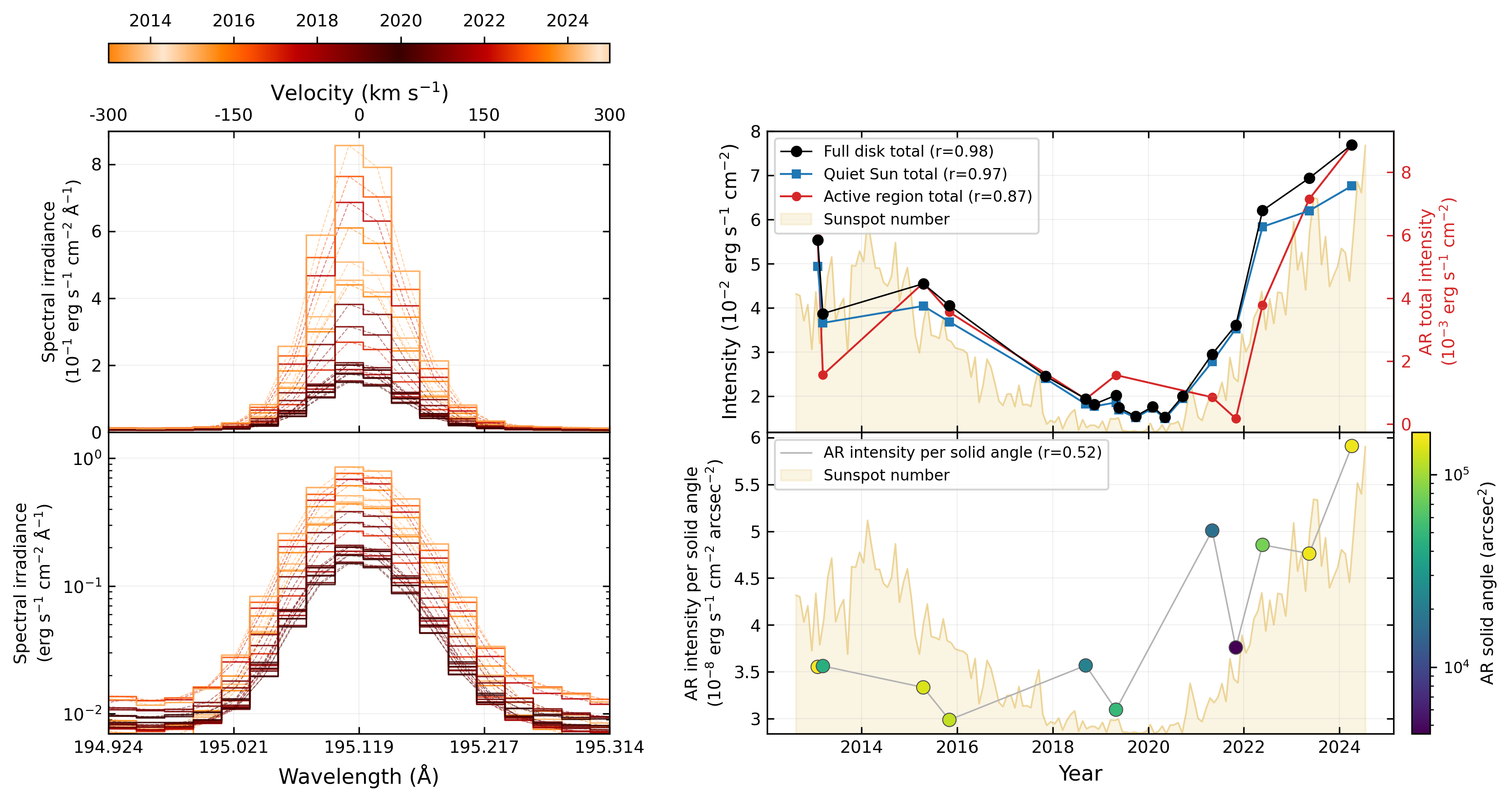
Figure 2: Left: Sun-as-a-star spectra around Fe XII 195.119 at different points in the solar cycle, with linear and logarithmic intensity axes (top and bottom panels respectively). Right: The total intensity of the full disk, quiet Sun, and active region plasma for each disk in the series (top). The sunspot number is shown to illustrate the solar cycle, and the correlation coefficients between the intensities and the sunspot number are shown in the legend. The active region intensity normalised by solid angle for each of the disks, with the solar cycle (bottom). Points are coloured according to the total active region solid angle. The sunspot number and correlation coefficient are also shown. The active region intensity for the October 2017 and May 2019 disks are excluded due to their small solid angle and incidence with bad data (see Figure 1).
Solar Cycle Dependence
The lower-altitude enhancement in turbulent velocity observed at C2 differs
from typical flare profiles, where such peaks are generally found higher in the
atmosphere. This behavior points to enhanced wave activity and energy deposition
in the mid-chromosphere, consistent with processes operating below the
fractionation layer. These findings suggest that sub-chromospheric dynamics,
including reconnection and wave generation, may play a role in establishing the
conditions required for IFIP fractionation.
We then considered the total disk-integrated Sun-as-a-star emission across the solar cycle, and the integrated emission from our different disk features. We found the total full-disk, quiet Sun, and active region emission to be strongly positively correlated with the solar cycle. To examine the variation of total active region intensity with the solar cycle, we normalised our measurements by the active region solid angle on each of the disks, and found a moderate residual positive correlation with the solar cycle. We show these results in Figure 2.
Our results show an invariance of key plasma parameter distributions with the solar cycle, and that disk-integrated coronal intensity is strongly correlated with the solar cycle, consistent with stellar observations. Taken together, these results support the hypothesis that Sun as-a-star coronal intensity variability across the solar cycle is driven primarily by the changing fraction of the disk occupied by active regions, rather than by changes in the log T 6.2 plasma properties of those regions. The residual correlation between the solar cycle and active region intensity might mean that active regions near solar maximum are more complex or hold higher unsigned magnetic flux (consistent with the findings of Pevtsov et al., 2003), but it could also just be a side effect of diffuse emission at the boundaries of the active regions which is captured by our masking technique.
Read the full paper for more details:
McKevitt, J., Ugarte-Urra, I., Young, P. R. (2026b). Full-Disk Spectroscopy of the Solar Corona Across a Solar Cycle with Hinode/EIS. Front. Astron. Space Sci.
References
1. Bobra, M. G., Sun, X., Hoeksema, J. T., Turmon, M., Liu, Y., Hayashi, K., et al. (2014). The helioseismic and magnetic imager (HMI) vector magnetic field pipeline: SHARPs-space-weather HMI active region patches. Sol. Phys. 289, 3549-3578.
2. Culhane, J. L., Harra, L. K., James, A. M., Al-Janabi, K., Bradley, L. J., Chaudry, R. A., et al. (2007). The EUV imaging spectrometer for hinode. Sol. Phys. 243, 19-61.
3. Jarolim, R., Veronig, A. M., Hofmeister, S., Heinemann, S. G., Temmer, M., Podladchikova, T., et al. (2021). Multi-channel coronal hole detection with convolutional neural networks. Astronomy and Astrophysics 652, A13.
4. Kosugi, T., Matsuzaki, K., Sakao, T., Shimizu, T., Sone, Y., Tachikawa, S., et al. (2007). The hinode (Solar-B) mission: an overview. Sol. Phys. 243, 3-17.
5. McKevitt, J., Matthews, S., Baker, D., Reid, H., Brooks, D., Ugarte-Urra, I., et al. (2026a). Coronal non-thermal and doppler plasma flows driven by photospheric flux in 28 active regions. Publ. Astronomical Soc. Jpn. 78 (3).
6. Morgan, H., and Taroyan, Y. (2017). Global conditions in the solar corona from 2010 to 2017. Sci. Adv. 3, e1602056.
7. Orlando, S., Peres, G., and Reale, F. (2001). The Sun as an X-Ray star. IV. The contribution of different regions of the Corona to its X-Ray spectrum. Astrophysical J. 560, 499-513.
8. Pevtsov, A. A., Fisher, G. H., Acton, L. W., Longcope, D. W., Johns-Krull, C. M., Kankelborg, C. C., et al. (2003). The relationship between X-Ray radiance and magnetic flux. Astrophysical J. 598, 1387-1391.
9. Scherrer, P. H., Schou, J., Bush, R. I., Kosovichev, A. G., Bogart, R. S., Hoeksema, J. T., et al. (2012). The helioseismic and magnetic imager (HMI) investigation for the solar dynamics observatory (SDO). Sol. Phys. 275, 207-227.
Next EIS Nugget »» coming soon...
TBC
Last Revised: 27-Oct-2011
Feedback and comments: webmaster
|


